

The Mall Y'all

You don’t have to look too hard to clock the world deteriorating before our eyes. The signs are everywhere–climate change, war, AI criticizing your life choices (I already have a mom, thanks!). And don’t get me started on why Peeps are now a thing for every single holiday! But nowhere is the decline of our civilization more evident than in the tragic state of the American mall.
Ah THE MALL! My Gen X readers read that and had to wipe a little bit of drool from their lips. This once great, hulking, hallowed structure of glass, tile, and adolescent coolness and school delinquency has become a social punchline. The mall is a retail embarrassment, a kitschy extra in the dystopian film or TV show of the moment, a nostalgic shadow of its glorious neon former self. Where once stood the proud, expensive United Colors of Benetton and Tower Records now houses something called Brow Bling and a store that sells plushy emojis. How I mourn the modern mall.
The mall concept came out of the economic boom of the 1950s. After having survived a second world war, the newly minted middle class decided the best way to celebrate was by building cookie cutter houses and buying lawn mowers and grills. Suburbia ushered in a whole new way of life. Home became mission control, socially speaking. Parties, picnics, and other gatherings primarily took place at someone’s house. Work was another location in post-war life where people (i.e. MEN) socialized (i.e. drank at their desks). But communities also require what sociologist Ray Oldenburg defined as a “third place” outside of work or home where people can interact and form bonds. Bars, community centers, parks or commons often served this function and still do. However, there was a man who was watching the suburban bloom and the rapidly expanding highway systems connecting towns and cities with great interest. The time seemed ideal to kick this whole “third place” situation up a notch, to cater to modern tastes for leisure, consumption, and Orange Julius. His vision would become a “third place” to rule them all (Tolkeinly speaking).
Victor Gruen was an American architect who founded the Victor Gruen Associates architectural firm in Los Angeles in 1951. Up until this time he had made his career designing boutiques and store fronts. But he had other ambitions. In 1954 Gruen pioneered the Northland Mall in Detroit, his first attempt at creating a version of downtown retail space concentrated in one area. The initial success of Northland spurred Gruen’s masterpiece completed two years later: The Southdale Mall in Edina Minnesota.
For 1956 this mall was LIT! Coming in at an impressive 800,000 square feet, this retail spitfire not only had stores, it also featured art installations, fountains, and even…wait for it…… A DANG BIRD SANCTUARY! Sure, you thought working at Pretzel Time was punishing. Try literally dodging crap during your six hour shift at the bird sanctuary.
The Southdale Mall was so *chef’s kiss* at the time that people compared it to Disneyland, which had opened a year before. This reflects the extraordinary and novel nature of Gruen’s genius. It also reflects how badly people were starved for entertainment in 1956.
Mall–retailers wanted to be you; Americans wanted to be IN you. Your moment was truly underway. By 1960 there were more than 4,500 shopping centers across the country. In a little over a decade malls accounted for 33% of retail sales in the United States. That is a lot of Bonne Bell lip gloss. Unfortunately for Gruen he watched his urban design triumph circle the porcelain drain as economics won out over the communal benefits Gruen originally envisioned. For instance, Gruen foresaw apartments, medical facilities, green spaces, and even schools as integral to the mall industrial complex. Sadly he would not live to see any of that materialize. In 1978 Gruen gave a speech in London where he bitterly disavowed what the mall had become: “I refuse to pay alimony for those bastard developments. They destroyed our cities.” Harsh. Barley.
Instead of bird sanctuaries, planners installed food courts. The lot next door that might have been green space was a gigantic parking structure. It was these and other types of short sighted developments that caused Gruen to spit on his work and call “Garbag!” But as we know, one Gruen’s trash is a Gen Xer’s treasure.
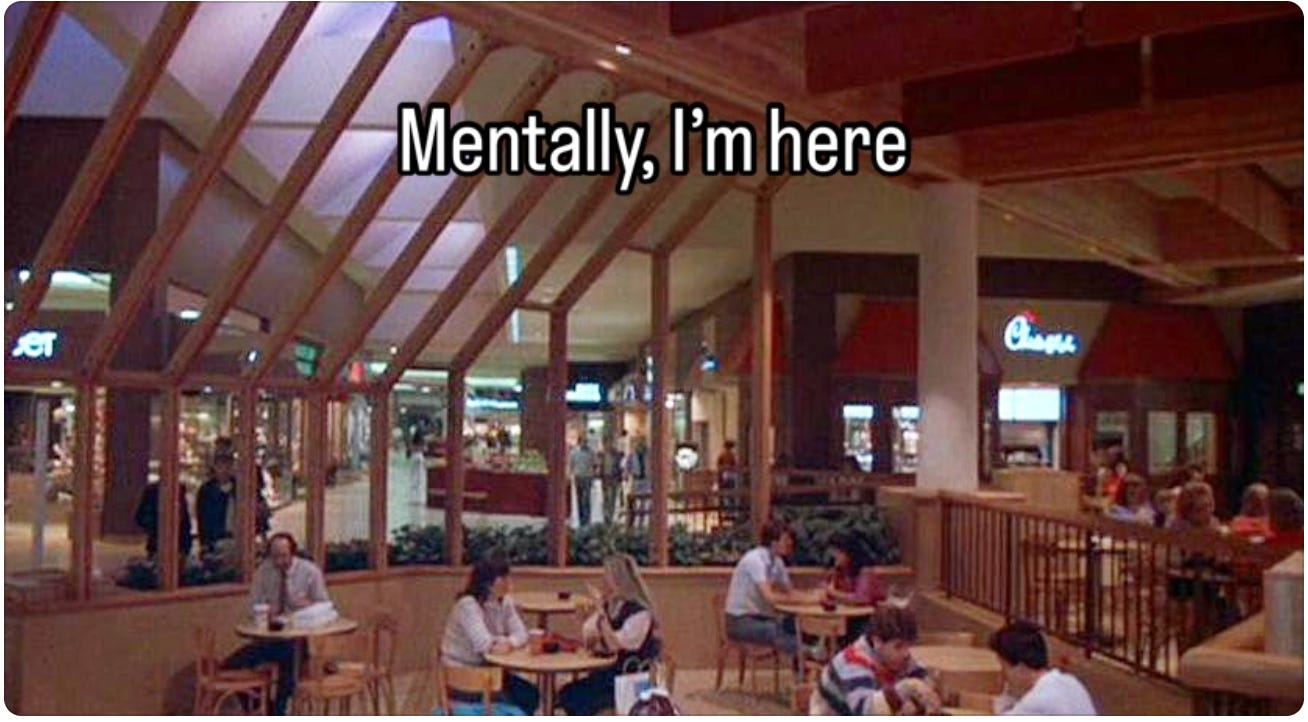
Welcome 1980s! The high holy decade of THE MALL! These places–not cotton–were the fabric of our lives. In fact, the 1986 Consumer Reports cited the mall as one of the top 50 “wonders” to revolutionize the lives of American consumers. Other things that made the list were antibiotics, personal computers, and oral contraceptives. Given that the mall was often ground zero of horny teens, the birth control connection checks out.
As marvelous as these shopping centers were, it’s important to note that not all malls were created equal. Maybe you were one of the lucky ones. Maybe your mall was a brick and mortar Shangri-La. Two (or more !!!) floors. Light. Airy. A food court to rival the stalls of London, the markets of Istanbul. Maybe yours had an arcade, a movie theatre–stop! I know. I’m dizzy just thinking of it, too. Was your mall cool enough to host a Barbie fashion show featuring models styled as living Barbie dolls? Were you at one of the storied occasions to witness the birth of the teen pop sensation known as Tiffany who literally launched her career TOURING IN MALLS?! Ed Sheeran, are you reading? GET UP ON THIS! IT’S NOT TOO LATE!
I was not as fortunate. My hometown mall was a non-descript, one-story plaza. We didn’t have a food court, but we had a Papa Gino’s pizza place, and if you had $5 you could afford a slice and drink combo and, golly, that was real nice. Real nice. There were a strange patchwork quilt of stores in the mall: Child World toy store (Kay Bee Toys’ bastard cousin), Bradlees (like Target, but minus all the interesting departments), Channel Hardware, a cigar store, because, sure, a Radio Shack where all the dads in town stocked up on batteries and extension cords. I remember a small pet store that smartly put their fish tanks in the window because, unlike a puppy, you couldn’t tell by looking at a fish if it was depressed. This is what we had. This is what we knew. Hard times. Hard times, indeed.
And should you have the opportunity, nay, the privilege, of visiting a different mall, a has-an-escalator-superior mall–oh the shame and loathing flooding through you upon your return! Trying to convince your mother to drive you 25 minutes to that OTHER mall because it was way better was harder than snatching the hair from a giant’s beard. “You have a perfectly fine mall here,” she’d say. Lies. Falsehoods. What did she know? NOTHING! In 1984 hell was knowing about a cooler mall within reach and being kept from it.
We made something remarkable from Oldenburg’s “third space,” and it had less to do with shopping than it did with feeling like you had autonomy in this home-away-from-home kind of place. The mall became a domain where we tried out adult rituals–dating, flirting, crying over a plate of cheesy fries because it, is like, so totally, over with Kevin. And we did so without the policing of actual adults like teachers, parents, or coaches.
You went to the mall to hang out, to goof around, to see who else might be there. There was a sense of possibility in these spaces precisely because they weren’t so militantly defined by what you were supposed to do. Instead, as long as you weren’t breaking stuff or being a criminal nuisance, you could kind of be what you wanted and be in the atmosphere with your friends how you wanted.
For me, this often involved hanging out with my friend Darylynn. We’d roam around, lapping through stores where we’d make fun of the outrageous jewelry or ludicrous clothes. I’d stand next to a mannequin and do a silly voice, narrating as the figure or I’d make up a commercial on the spot like I was auditioning for Saturday Night Live. I was just having fun and goofing around and doing what came natural to me in that particular setting, surrounded by all that juicy inspiration! People who know me or who have been out in public with me know that this is actually my default setting. I still do this dopey, silly stuff, pretty much everywhere. I’d like to say not funerals, but I can’t.
I didn’t realize it then, but spending all that time at the mall doing nothing constructive gave me the freedom to be more of myself than I was in other places.
Malls are still a thing, but it feels like they are trying just a bit too hard, bringing that cringey “I’m the cool mom” energy. Some are going with luxury and high-end retail, others are aiming for the fun-o-rama brand with laser tag, bowling alleys, Dave and Buster type entertainment emporiums. That’s a choice, sure. But kids have movie theatres in their pockets, on their wrists. I don’t know if they need their attention coopted more than it already is on a regular basis. Maybe what they could actually use is a classic, old school “third space” mall where they can hang out, see what happens.
Announcey Bits!
It was a pure pleasure to be featured in Jade Walker’s Moonlight Reader Society’s newsletter! Have a look and get to know Jade and all the wonderful, uplifting work she’s doing around le Stack.
Mall talk have you all nostalgic or craving some form of the Cinnabun? Two great conversations starring the Lady Galleria of your Gen X dreams: Have a listen to this one I did with my pal Michael Estrin (Situation Normal, Slacker Noir) about the iconic 80s treasure Valley Girl. Follow it with a Fast Times at Ridgemont High chaser featuring my great friend Eric Pierce (All The Fanfare).
BOOKS! I got’em right here….
You want to read’em; I want to sell’em. Win/win!
The League of Extraordinarily Funny Women: 50 Trailblazers of Comedy (Running Press)
Boston and Beyond: Discovering Cities, Harbors, and Country Charms (Globe Pequot)
Book Lovers’ New England: A Guide to Literary Landmarks (Spring 2026 from Globe Pequot)
Oh I love this. I love malls. I saw a Connor o’Malley perform at a comedy club located in a mall. He referred to malls as a zoo for people. I think that’s pretty accurate!
Seeing Columbia Mall in Grand Forks, North Dakota last year kind of made this obvious for me. Where once there was life was there is now a collection of empty storefronts.
On the other hand, malls seem to be alive and well here in Canada. Maybe that was because we have less people than the U.S. and therefore can generate enough profits to stay in business without going broke spending for extras...