

Grill Baby Grill!

Hey Friends!
Quick note—I’ll be off next week following the July Fourth holiday. If you’re observing, stay safe, have fun, plot revolution, enjoy the ice cream, lay in the hammock, circulate articles of dissent, spend time at the beach, join the resistance, sleep late etc…
X! -S
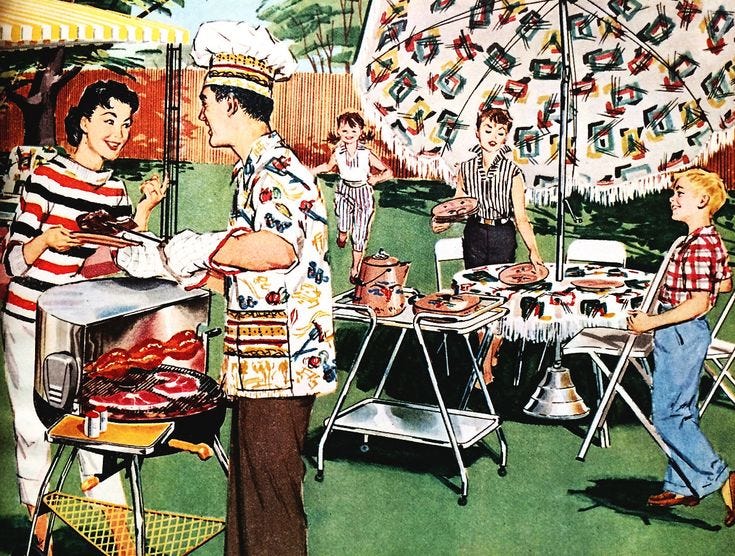
Oh how I longed to be a cookout family.
The Bradys, the Cunninghams, those plucky eight-is-enough blended Bradfords. Look how those well-adjusted television dads, outfitted in smart red and white striped aprons, helmed the grill like generals over culinary command. See that lovely glass pitcher of sunny lemonade, the kind with extra lemon slices floating on top like citrus life preservers, sitting out on the long picnic table covered in a checkered cloth. Here comes mom to put out the red and blue plastic cups. There goes Susie and Jimmy running around in the grass. Next to the grill is a pyramid of carbs in the form of hamburger and hot dog buns. With flipper in hand, dad tends to the hamburger patties, mashing down to get that perfect sear; he nudges over the Oscar Meyers, getting those grill lines nice and dark, really getting that charcoal to fuse to the meat and, eventually, our hapless intestines. So what’s a little carcinogens among friends? THAT’S what a real cookout hot dog looks and tastes like, you betcha Mr. C! Golly sure I’d love another! Maybe you could throw in a few life lessons while you’re at it!
Ain’t that America, baby, quoth the bard Cougar Mellencamp.
Of course cooking over fire has been around since prehistoric times. Back then it was less about gathering for a birthday or holiday and more about eating food in a way that would not kill you. The concept of the cookout–flame broiled fare in some kind of outdoor oven–has been an American ritual since the 1790s. In 1793 D.C. citizens held a cookout to celebrate laying the cornerstone of what would become the U.S. Capitol building. Not the only wieners that would ever be at the Capitol.
But it wasn’t until the 1950s that the cookout became synonymous with suburban, middle-class, Pleasant Valley Sunday American life. And that was in large part due to a man named George Stephens.
George worked for the Weber Brothers Metal Works in Chicago. The Webers manufactured a variety of metal items such as hinges, wagons, and buoys. How they did not sit around the conference room table going “Business is really BUOYOOOMING!” I’ll never know.
George lived in a suburb called Mount Prospect. Like a lot of folks in the neighborhood, George enjoyed cooking outdoors. He had even built himself a brick barbeque that used coals and a grate. The problem was that when high winds kicked up, which they always did in Illinois, they sent ash flying around all over the food, not to mention cooling off whatever was grilled, and not NOT to mention sparking forest fires that were never directly traced back to George or any of his drunk relatives.
If only there were some way to protect the grilling food from winds or even the previously mentioned drunk relatives, George pondered at the metal works one Monday after a particular incendiary backyard cooking “event.” Just then his gaze fell upon a buoy with its bulbous bottom resembling a bowl that one could fill with, I don’t know, charcoal briquettes and even, perhaps, fashion some kind of cloche or cover for the top of said flaming bowl, ideal for keeping out gusty winds and inebriated relatives. Hmm, George thought. Hmm, indeed.
And shortly after a third “hmmm” was uttered George’s Barbeque Kettle was born. And even more shortly after the Weber Brothers Metal Works cried “Those buoys are our IP!” and the newly named Weber Kettle hit the market, destined to revolutionize the backyard cookout for generations.
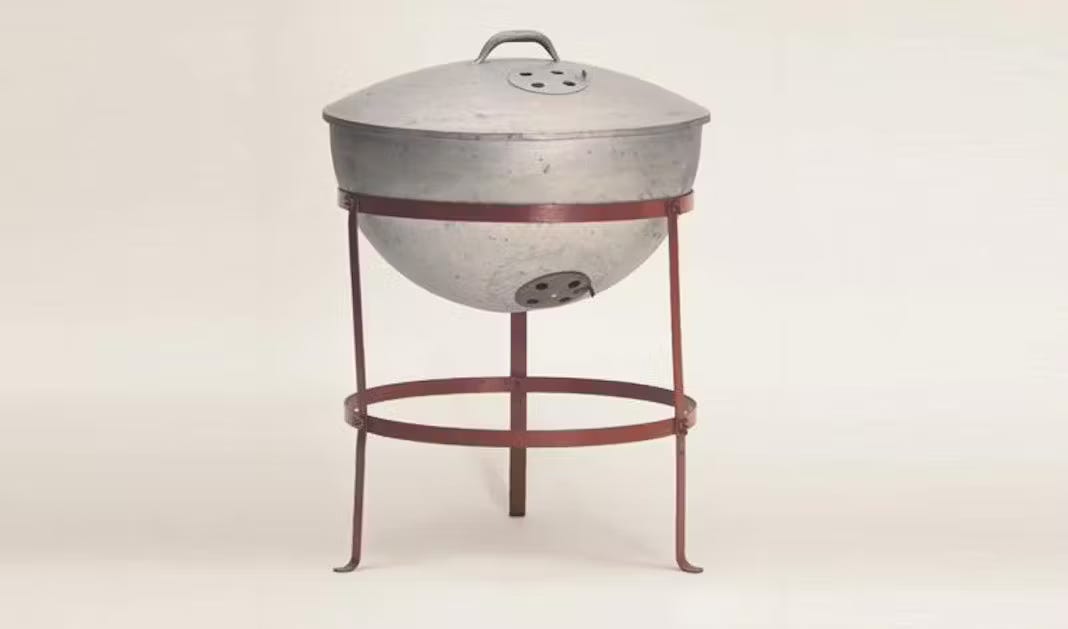
The portability and affordability of the Weber Grill meant that anyone with even a shoebox sized patio or lawn could participate in this popular American pastime. In their own way, cookouts furthered the myth of the happy nuclear family. Here was an activity for everyone, but especially for dad–chief cook. The cookout gave dad the thrill of roasting food over a flame like his ancient ancestors; it allowed him to perform a sanctioned kind of masculinity (apron be damned!); and it affirmed his conventional gender role as head of the household. Think big “master of his grill domain” energy.
Everyone else sort of fell into place around this scenario: homemaking wife, adoring kids, maybe even a dog. All is well. All is good. All is normal.
Not for us, it seemed. Neo-nuclear family of the 1980s. No Weber Kettle, no Coleman, no brick and stone chimney throwing sparks in the steamy July sundown in our backyard. No. We were a hibachi family, thank you very much. One that came into our lives via a sales contest my father won at work. I don’t know if that is worse than driving to a store with the express intent of purchasing a hibachi. Maybe the same.
If you’ve never encountered one of these, you can comfortably live the rest of your life and die satisfied and fulfilled. A hibachi is a small cooking stove. And that is a pretty generous description. Imagine a safe deposit box that doubles as an open flame stove. That is a hibachi.
Though this form of Japanese cooking has been around since the Heian period (designating things by period is shorthand for OLD ASS OLD), it caught on in popular retail markets in the late-60s and well into the 1980s, boosted by the decade’s preoccupation with Japanese goods and tech. The hibachi was great for small spaces like terraces or apartment decks or those tiny courtyard patios. We had a pretty big front and back yard, totally capable of handling the most basic Weber grill model. The biggest problem would have been deciding where to set it up. Believe me, for a mid-middle class family like ours in the early-1980s, this was considered a champagne problem. In fact, I bet one of those could have fit in EITHER of our two-car garage bays with plenty of space for my mother’s Buick, my father’s Cutlass, and the sputtering push mower my dad ran sparingly during the summer.
I wanted to die of embarrassment when my father carted out this metal contraption, usually around the Fourth of July (big occasion, hun! Getting out the hibachi!) and popped it onto the low stone wall that edged our sloping driveway. At least he put it near the bottom of the driveway close to the garage doors. This way he was shielded from the street view where, God forbid, someone else in the neighborhood passing by might see him. Looking back, I realize that was probably unrealistic since the other neighbors were too busy adult-sized grilling in their backyards.
He would sprinkle a handful of briquettes in the tray around noon so that by 4pm the coals would be hot enough to grill. Fortunately we were a family of four. This meant he could make two burgers–one for mom, one for my older brother–and then a burger and dog combo for himself and me and we’d still get to have our “cookout” dinner before midnight.
We’d convene at the picnic table in our screened in porch around our plates of gently seared food along with a big bowl of potato chips and make fun of my dad who labored all day in the driveway over the “grill” slightly bigger than a carburetor. Who, I would realize much later, maybe didn’t have the mental health to go all in on the shiny, suburban family thing with all its rituals and trends and expectations, but from time to time tried to play along, tried to make an effort, even if it was hibachi-sized.
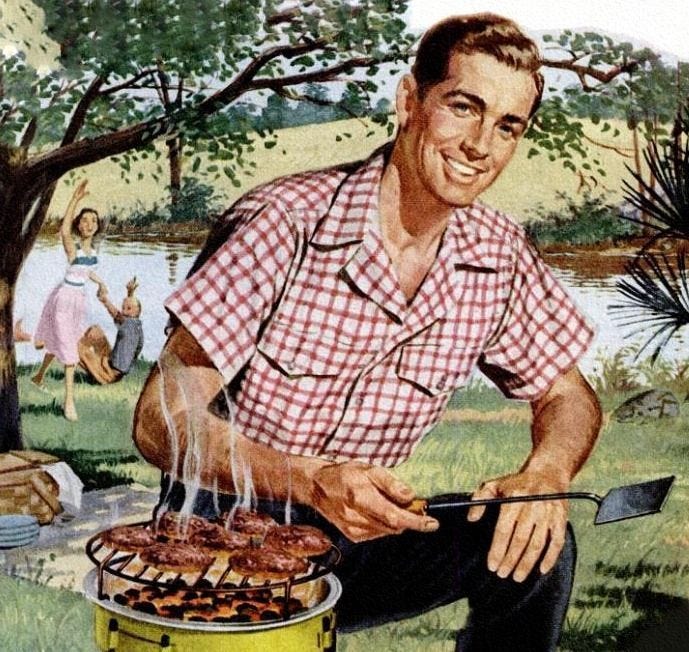

The sibling of the Hibochi, of course, is the Hitachi -- equally useful but in a different area of the home.
I remember my wistfulness in the early 1950s... wishing I had a "real" family, with parents that grilled on the patio, played with their children in the yard and tucked them safely into bed each evening. Like the Dick and Jane family of primary school readers. ( Who ARE those people?) It was part of a dream. My family, too, lacked "the mental health" to pull it off. Maybe that is why I was more likely to "plot revolution", and "circulate articles of dissent" in my adulthood. Loved this post Sheila. Thank you.